

Natural Nootropics vs Smart Drugs
Natural Nootropics vs Smart Drugs
The conversation about cognitive performance supplements has become a conversation about two fundamentally different philosophies. On one side: synthetic smart drugs, pharmaceutical compounds that produce acute, measurable cognitive effects by forcibly altering brain neurochemistry. On the other: natural nootropics, whole-food compounds that support the brain's own systems, building cognitive capacity over weeks and months rather than hours.
Both approaches are real. Both have clinical evidence behind them. Both attract serious, high-performing men. But they are not equivalent alternatives, they are different categories of intervention with different mechanisms, different risk profiles, and different outcomes over time.
This guide gives you an honest, evidence-based comparison of both. Not a polemic against synthetic drugs. Not a sales pitch for natural alternatives. A clear-eyed account of what each approach actually does — including what the research supports, what it doesn't, and what each one costs beyond the purchase price.
Disclaimer: This article is for informational purposes and does not constitute medical advice. If you are concerned about your health, speak to your GP. This content discusses food supplements, which are not intended to diagnose, treat, cure, or prevent any disease.
What Are Smart Drugs and What Do They Actually Do?
The term "smart drug" or "cognitive enhancer" covers a spectrum of synthetic compounds that share one characteristic: they produce measurable changes in cognitive performance by directly modifying neurotransmitter systems in the brain. Unlike natural nootropics, they do not work gradually or through nutritional support, they intervene directly and acutely in brain chemistry.
The most commonly discussed synthetic cognitive enhancers among healthy adults seeking performance enhancement are:
Modafinil
Schedule 4 · UK Prescription Only
Modafinil was developed as a wakefulness-promoting agent for narcolepsy and shift-work sleep disorder. Its cognitive enhancement profile in healthy individuals centres on sustained wakefulness, reduced fatigue perception, and improved working memory under sleep-deprived conditions. Its primary mechanism involves inhibition of dopamine reuptake, increasing dopamine availability in the prefrontal cortex, alongside effects on norepinephrine, histamine, and orexin systems.
In healthy, well-rested individuals, the evidence for significant cognitive enhancement beyond sustained wakefulness is considerably more mixed than the biohacking community's enthusiasm suggests. A comprehensive 2015 systematic review in European Neuropsychopharmacology found that modafinil's most consistent effects were on attention and wakefulness, with memory and executive function improvements more variable and context-dependent.
Legal UK status - Prescription only — Schedule 4
Tolerance development - Yes — with regular use
Sleep disruption risk - High — even with morning dosing
Best evidence for Sustained wakefulness, fatigue reduction
Amphetamine-Class Compounds
Class B Controlled Drug · UK
Adderall (amphetamine salts) and Ritalin (methylphenidate), prescribed for ADHD, are used off-label for cognitive enhancement in healthy individuals, particularly in competitive academic and professional environments. Their mechanism is straightforward: they massively increase dopamine and norepinephrine availability in the prefrontal cortex, producing acute improvements in focus, motivation, and sustained attention.
The cognitive effects are real and significant. The costs are also real and significant: strong dependency potential, cardiovascular strain, anxiety, insomnia, appetite suppression, and a pronounced rebound when they wear off. In the UK, possession without prescription is a criminal offence. The risk-to-benefit profile for healthy cognitive enhancement use is among the least favourable of any compound in this category.
Legal UK status Class B controlled drug without prescription
Dependency risk High — established addiction profile
Cardiovascular risk Elevated — not suitable for unsupervised use
Cognitive effect Acute and significant — at significant cost
Piracetam & Racetams
Prescription / Grey Area · UK
Piracetam, the original racetam synthesised in 1964, modulates AMPA glutamate receptors and increases acetylcholine activity in the hippocampus, the brain region most directly involved in memory formation and recall. It also increases cerebral blood flow and membrane fluidity. The racetam family has since expanded to include aniracetam, oxiracetam, pramiracetam, and phenylpiracetam, each with variations in potency, mechanism, and evidence base.
The clinical research on racetams is extensive but heavily weighted toward populations with cognitive impairment, elderly patients, those recovering from brain injury, or those with diagnosed conditions. Evidence for meaningful cognitive enhancement in healthy adults is substantially weaker. Most racetam users in healthy populations report needing supplemental choline alongside the drug to avoid headaches, a practical signal that racetams are depleting cholinergic reserves.
Legal UK status - Piracetam: prescription only. Others: grey area
Choline depletion - Common — requires supplementation
Evidence in healthy adults - Limited compared to clinical populations
Best evidence for Cognitive impairment, age-related decline
The honest position on smart drugs
Synthetic cognitive enhancers produce real effects. This guide does not dismiss them. But the honest picture includes the tolerance development, the legal status in the UK, the rebound effects, the dependency risk, and the fundamental question of whether borrowing cognitive performance today creates a deficit tomorrow. These are the questions the biohacking community frequently skips.
The Core Distinction: Borrowing vs Building
Understanding the difference between synthetic smart drugs and natural nootropics requires understanding one fundamental distinction, the difference between borrowing cognitive performance and building cognitive capacity.
Synthetic Smart Drugs
Borrowing Against Tomorrow
Synthetic cognitive enhancers work by increasing the availability of neurotransmitters, dopamine, norepinephrine, acetylcholine, beyond what the brain would naturally produce at that moment. The effect is real and immediate. But the brain regulates neurotransmitter production through feedback loops: when availability is artificially elevated, production is reduced. The cognitive performance gained today comes from reserves that need replenishing. Regular use requires increasing doses as tolerance builds. The crash when the drug wears off is the repayment schedule.
Natural Nootropics
Building Structural Capacity
Natural nootropics work by improving the conditions under which the brain naturally performs. Lion's Mane stimulates Nerve Growth Factor, building the neural architecture that underlies cognitive performance. Bacopa Monnieri increases acetylcholine availability through enzyme modulation rather than depletion. Cordyceps improves oxygen utilisation at the mitochondrial level. These changes are structural and cumulative. The brain at week 12 of Lion's Mane supplementation genuinely has more NGF, more neuroplasticity, and more resilience than at week one. Nothing has been borrowed. Everything has been added.
"Smart drugs produce cognitive output by drawing on reserves. Natural nootropics build the reserves. One is an advance on future earnings. The other is the earnings themselves."
Natural Nootropics: The Evidence for a Different Approach
Natural nootropics are not a polite euphemism for "supplements that don't really work." The compounds with the strongest clinical evidence have human trial data that, for specific cognitive outcomes over specific timeframes, compares favourably with the evidence for racetams in healthy adults and does so without the legal, dependency, and safety concerns.
Lion's Mane Mushroom
NGF Stimulation · Fruiting Body
Lion's Mane (Hericium erinaceus) contains hericenones, compounds that cross the blood-brain barrier and stimulate the synthesis of Nerve Growth Factor (NGF). NGF regulates the survival, maintenance, and growth of neurons. This is not an acute neurotransmitter effect, it is structural neuroprotection and neuroplasticity support that builds over consistent daily supplementation.
Unlike synthetic nootropics, which produce effects by overriding neurotransmitter regulation, Lion's Mane supports the brain's own maintenance and growth systems. The critical specification: fruiting body extract only. Mycelium-on-grain products contain significantly lower concentrations of hericenones and should not be considered equivalent.
Key Evidence
Mori et al. (2009, Phytotherapy Research): 30 adults given Lion's Mane fruiting body extract for 16 weeks showed significantly higher cognitive function scores vs placebo at weeks 8, 12, and 16. Double-blind, randomised, placebo-controlled. Scores declined after discontinuation, confirming the effect was not placebo.
Bacopa Monnieri
Acetylcholine Support · Antioxidant
Bacopa's active compounds, bacosides A and B, increase acetylcholine availability through cholinergic support rather than depletion. They increase the activity of choline acetyltransferase (the enzyme that produces acetylcholine) while reducing acetylcholinesterase (the enzyme that breaks it down). The net effect is sustained improvement in acetylcholine availability, the neurotransmitter most directly involved in memory formation and learning.
This is mechanistically superior to racetams for healthy adults in one important respect: Bacopa supports acetylcholine synthesis, whereas racetams increase acetylcholine activity through receptor modulation while simultaneously depleting reserves, which is why racetam users require choline supplementation, and Bacopa users do not.
Key Evidence
Stough et al. (2001, Psychopharmacology): 76 adults given standardised Bacopa extract for 12 weeks showed significant improvements in spatial working memory accuracy, speed of early information processing, and rate of learning vs placebo. Effects not present at 5 weeks, confirming consistent long-term supplementation is required.
Cordyceps Militaris
Mitochondrial ATP · Oxygen Utilisation
Cordyceps enhances cognitive performance through the most fundamental pathway available: improving how efficiently brain cells use oxygen. The brain accounts for 20% of total oxygen consumption despite representing 2% of body weight. Cordyceps' active compound cordycepin increases mitochondrial ATP synthesis and cellular oxygen extraction efficiency, meaning the brain gets more energy from the same oxygen supply.
This approach addresses cognitive performance at the energy level rather than the neurotransmitter level, making it complementary to rather than competing with both Bacopa (cholinergic) and Lion's Mane (NGF). The three compounds together address three different aspects of cognitive performance simultaneously.
Key Evidence
Trexler et al. (2016, Journal of Dietary Supplements): Cordyceps militaris supplementation for 3 weeks produced an 11% increase in peak VO2 max versus placebo, confirming improved oxygen utilisation. Cognitive fatigue reduction was observed as a secondary finding.
Matcha (L-Theanine + Caffeine)
Immediate · Alpha Wave · Calm Alertness
Matcha provides the one area where natural nootropics offer something comparable to the acute effects of synthetic stimulants: immediate, calm, focused alertness. The L-theanine to caffeine ratio in matcha (approximately 1:1 to 2:1) produces a cognitive state that clinical research consistently describes as qualitatively superior to caffeine alone, improved attention and reaction time without the anxiety, cortisol spike, or crash that isolated caffeine produces.
This is the natural stack's answer to modafinil's acute wakefulness effect, not equivalent in absolute terms, but without the prescription requirement, tolerance development, or sleep disruption. For most men seeking sustained professional performance rather than exam-night desperation, it is the more intelligent choice.
Key Evidence
Haskell et al. (2008, Biological Psychology): L-theanine and caffeine in combination significantly improved accuracy on demanding cognitive tasks, faster alerting and reaction times, and reduced susceptibility to distraction compared to caffeine alone or placebo. Double-blind, placebo-controlled crossover.
The Head-to-Head: A Complete Comparison
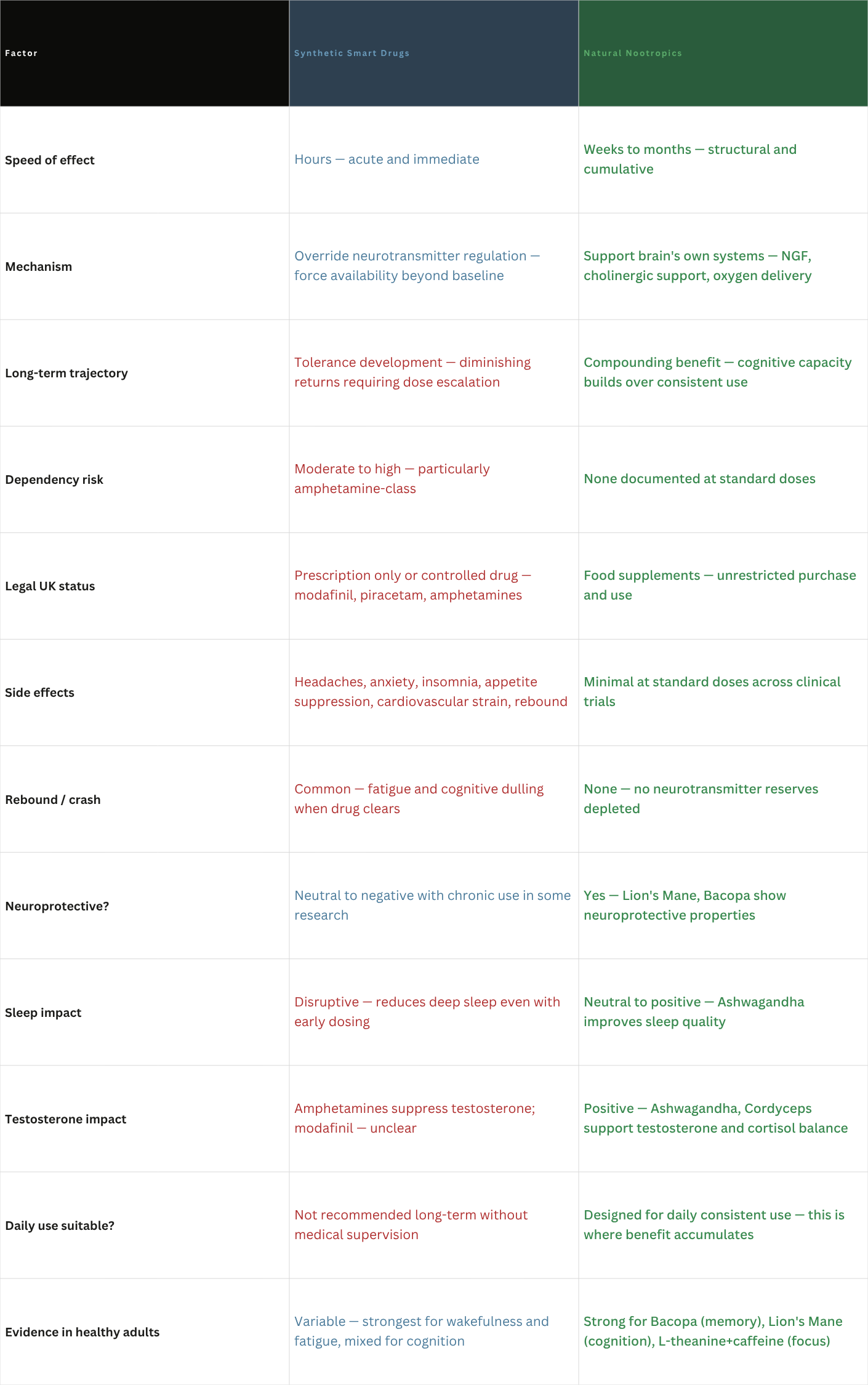
Who Each Approach Is Actually For
The honest answer to "which should I use?" depends entirely on what you are optimising for and over what time horizon.
The case where synthetic drugs make sense
A man facing an extraordinary, one-off cognitive demand, a critical examination, a complex analysis under a time constraint with no sleep, may find a synthetic wakefulness agent useful in that specific context, where short-term acute performance is required and the long-term costs are acceptable for a single occasion. This is not an argument against them. It is a narrowly specific context in which their acute effects are the right tool.
The case where they do not
The man who needs to perform well every day, for years, the entrepreneur, the professional, the father operating at high cognitive output across a long career, is poorly served by synthetic cognitive enhancers. Tolerance development means escalating doses. Rebound fatigue means worse performance in the off-periods. Sleep disruption means degraded testosterone, poorer memory consolidation, and a compounding cognitive deficit. The chronic high performer cannot afford to borrow against his cognitive reserves. He needs to build them.
The whole-food advantage at 90 days
At day one, synthetic smart drugs win. At day ninety, the picture reverses. A man who has taken Lion's Mane, Bacopa, and Cordyceps consistently for three months has measurably more NGF, better cholinergic function, and improved oxygen utilisation. His baseline cognitive performance has shifted upward. The man who relied on modafinil for three months is dealing with tolerance, intermittent fatigue, and potentially disrupted sleep. The 90-day horizon is where natural nootropics become the dominant choice by a significant margin.

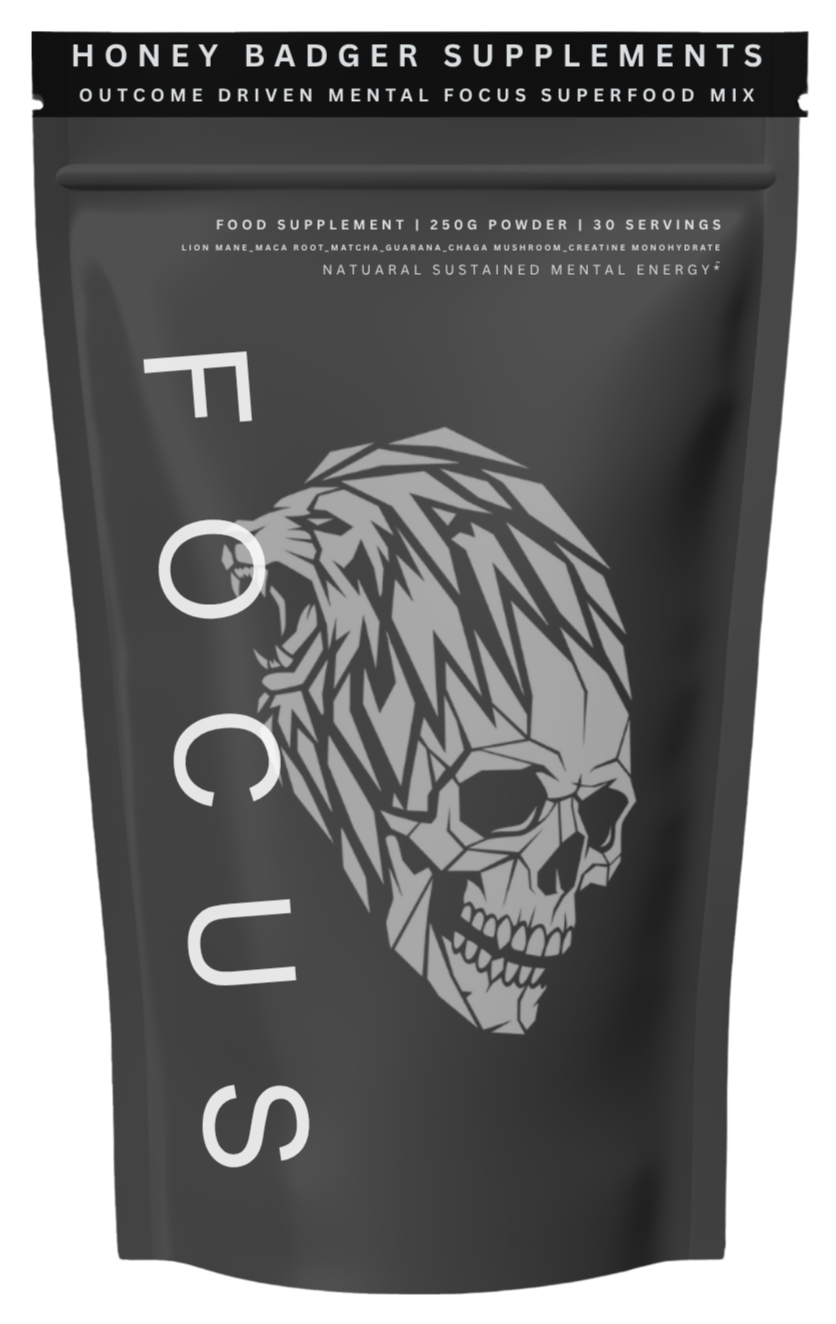
Honey Badger Supplements · Focus Formula
FOCUS - Natural Nootropic Superfood Formula
Lion's Mane, Bacopa Monnieri, Cordyceps, Matcha, Guarana, Chaga, Ashwagandha. UK-made. No synthetic stimulants.
Can You Combine Both Approaches?
This question deserves a direct answer: yes, with specific caveats.
Natural nootropics and occasional, judicious use of synthetic compounds are not mutually exclusive for a man who understands what each one does and monitors his own response honestly. Bacopa's cholinergic support, for instance, may actually reduce the risk of choline depletion associated with racetam use, since both are working on the same system from different angles.
The important qualifications:
Natural nootropics should be the foundation, not the afterthought. Building consistent NGF stimulation, cholinergic health, and mitochondrial efficiency provides the platform from which any acute cognitive tool performs better
Synthetic stimulants should never replace sleep. Using modafinil to compensate for poor sleep destroys testosterone, disrupts the glymphatic system (which clears neural waste overnight), and compounds cognitive impairment over time regardless of the acute wakefulness effect
Tolerance breaks matter. If using any synthetic stimulant, regular periods of abstinence are essential to prevent receptor downregulation and maintain baseline sensitivity
Caffeine is the exception. Matcha provides a natural caffeine-L-theanine combination that is sustainable daily without meaningful tolerance development at moderate doses, this is the acute performance tool that fits within the natural nootropic framework without the costs of pharmaceutical compounds
The Honest Case for Whole-Food Cognitive Support
Honey Badger's approach to cognitive performance is not positioned against synthetic smart drugs because they are dangerous. They are not all dangerous. It is positioned against them because they are the wrong tool for the man who needs to think clearly and perform consistently across years and decades, not just hours.
The whole-food cognitive support model asks a different question. Not "how do I get more from my brain today?" but "how do I build a brain that performs better tomorrow than it does today?" The answer to that question is structural: NGF stimulation, neuroplasticity, cholinergic health, mitochondrial efficiency, reduced neuroinflammation, and the hormonal environment, particularly testosterone, that underpins cognitive drive and motivation.
These are the things natural nootropics build. They are the things synthetic smart drugs cannot, because they operate in the wrong direction, extracting performance rather than producing it.
The man who is still thinking clearly at 55 with the same drive and cognitive edge he had at 35 is not the man who used modafinil for twenty years. He is the man who built the foundation sleep, training, diet, stress management, and whole-food supplementation and let it compound.
Not sure where to start?
TAKE the Performance Assessment.
CHANCE TO WIN 3 MONTHS SUPPLY OF LIFE OR DEATH
Frequently Asked Questions
What is the difference between natural nootropics and smart drugs?
Smart drugs are synthetic pharmaceutical compounds that force changes in brain neurochemistry, increasing dopamine, norepinephrine, acetylcholine, or glutamate beyond normal physiological levels. They produce acute, significant cognitive effects but carry dependency risk, tolerance development, legal barriers, and a rebound when they wear off. Natural nootropics work with the brain's own systems, stimulating NGF production, supporting cholinergic health, improving oxygen utilisation, and reducing neuroinflammation. Effects build over weeks and months rather than hours, and they compound rather than deplete.
Is modafinil safe for long-term use?
Modafinil is a Schedule 4 prescription-only drug in the UK, illegal to import or possess without a valid prescription. The evidence for long-term cognitive enhancement use in healthy individuals is limited. Regular non-medical use is associated with tolerance development, rebound fatigue, sleep architecture disruption even with morning dosing, headaches, anxiety, and dependency-related concerns in some users. Natural nootropics carry none of these legal or dependency concerns and are designed for consistent daily use without tolerance development.
Do racetams work for cognitive enhancement?
Racetams have a substantial body of clinical research, but most of it is conducted in populations with cognitive impairment rather than healthy adults. Evidence for significant cognitive enhancement in healthy individuals is considerably weaker. Most racetam users require supplemental choline to avoid headaches, a signal that racetams deplete cholinergic reserves. In the UK, piracetam is prescription-only. The evidence base for Bacopa Monnieri in healthy adults comparing on memory and processing speed is at least as strong as racetams, without the legal status, choline depletion, or side effect profile.
What are the best natural alternatives to modafinil?
For sustained cognitive performance, the strongest natural alternatives are Lion's Mane (NGF stimulation, 16-week RCT showing significant cognitive improvement), Bacopa Monnieri (working memory and processing speed at 8–12 weeks), Cordyceps (oxygen utilisation and mental energy), and Matcha (L-theanine plus natural caffeine for immediate calm alertness). These do not replicate modafinil's acute wakefulness effect, they build sustained cognitive capacity that makes that kind of acute intervention less necessary over time.
Are smart drugs legal in the UK?
Modafinil is a Schedule 4 controlled drug in the UK legal to possess only with a valid prescription, and illegal to import without one. Piracetam is a prescription-only medicine. Many newer racetam derivatives exist in an ambiguous legal status that changes as the MHRA updates classifications. Natural nootropics, Lion's Mane, Bacopa Monnieri, Cordyceps, Matcha, Guarana, Ashwagandha, are food supplements with no prescription requirement and no legal restrictions on purchase or use in the UK.
Do natural nootropics build up over time?
Yes, this is their defining characteristic. Lion's Mane stimulates NGF production progressively, structural neuroplasticity builds over weeks. Bacopa's memory improvements are significant at 12 weeks in clinical trials and continue to build. Cordyceps' mitochondrial efficiency improvements compound with consistent use. This is the opposite of synthetic smart drugs, which show tolerance development over time, requiring dose escalation as the effect diminishes. Natural nootropics build cognitive capacity. Synthetic drugs borrow against it.
The Summary
There is a version of this article that takes a moralistic position against synthetic smart drugs. This is not that article. Smart drugs are real compounds with real effects and real clinical research. For specific acute demands, in specific contexts, used judiciously, they are not irrational choices.
But the man seeking sustainable, compounding cognitive performance across a demanding career and a demanding life is asking a different question and that question has a different answer. The whole-food nootropic approach does not win at day one. It wins at day ninety, and at year five, and at the decade of professional output during which the smart drug user's baseline has been held constant or eroded by tolerance and dependency while the natural nootropic user's baseline has continued to rise.
Smart drugs produce cognitive output by drawing on neurochemical reserves. Natural nootropics build the reserves.
One is a withdrawal from an account. The other is a deposit. The difference compounds over time in exactly the direction you would expect.